Removals insurance, more accurately called goods in transit cover, protects your belongings while they're in a mover's hands rather than in your own home. It's a different thing from home contents insurance. Most contents policies stop covering your possessions the moment they leave your front door. Some only cover them in transit under a specific add-on most people never check.
If you're reading this before booking a move, you're asking the right question at the right time. Below: what goods in transit cover means, how it differs from full replacement cover, what changes if you pack your own boxes, what's usually excluded, and what to ask before you book.
Goods in transit cover is insurance a removal company holds to protect your belongings while they're carried, loaded, or stored during the move. It sits with the mover, not with you. It's separate from any insurance you hold personally.
Home contents insurance centres on your address, not your belongings in motion. Most policies only protect items inside the property named on the policy. The moment a sofa leaves through your front door, it may already sit outside what your contents insurer will pay for. Check your policy for a specific "in transit" extension if you want certainty either way.
This is exactly why goods in transit cover exists as its own category. It's the mover's responsibility to carry it. A reasonable question before booking is simply whether they do.
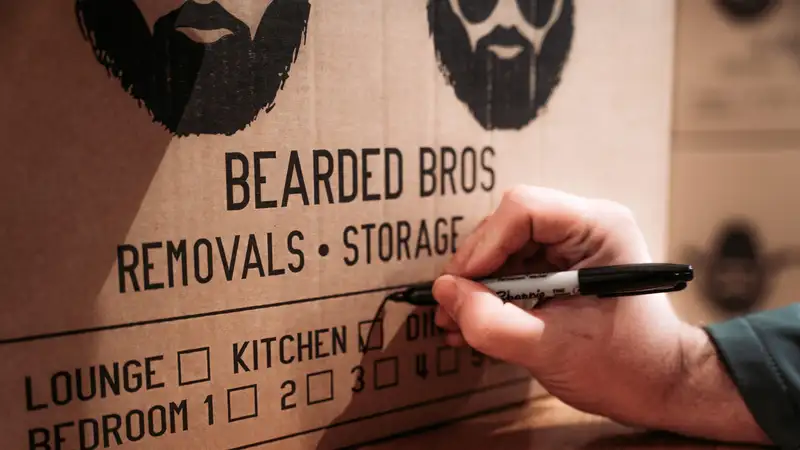
Removals liability cover generally works on a declared value basis. You state what your belongings are worth. That figure is what the cover responds to if something is lost or damaged, up to the policy's limit.
Bearded Bros' hourly rate removals include standard liability cover up to £5,000 of declared value. To benefit from it, declare the full, like-for-like replacement value of everything you're moving on your acceptance and inventory forms. If the total value exceeds £4,999.99, you can arrange additional liability cover, charged according to the value you declare. Fixed price quotes carry their own liability cover within the price, set out on the quote itself.
Storage works on a similar principle. Bearded Bros' crated storage carries standard liability cover up to £1,000 of declared value, using the same inventory and declaration process. Self-storage goods need insuring too, either through Bearded Bros (charged per £1,000 of cover, per week) or your own policy, with proof of cover if you arrange it yourself.
This is a good moment for honesty about what's still open. Bearded Bros hasn't published the specific insurer behind this cover, or any excess on a claim, on its website at the time of writing, so ask for that detail directly on your quote call.
This is the part almost nobody checks, and it changes what you'd actually get back if a claim goes wrong.
Mover's liability cover, sometimes called limited liability, doesn't automatically mean the full replacement cost of a damaged item. It means the cover responds up to the declared value you gave them. Depending on the policy's terms, the insurer can calculate a payout differently to what you'd expect, sometimes weighing age and condition rather than price when new.
Full replacement cover is a distinct, usually optional, level of cover. It pays what it would genuinely cost to replace an item like-for-like. It typically costs more, since the insurer takes on a bigger risk.
The takeaway isn't that one is good and the other bad. It's that "insured" isn't a single fixed thing. The level of cover behind that word can vary a lot between quotes that look similar on price. Ask exactly what basis the insurer uses to work out a payout, not just whether cover exists.
| Mover's (standard) liability cover | Full replacement cover |
|---|---|
| Responds up to your declared value, based on the policy's own calculation method | Pays what it would cost to replace the item new, like-for-like |
| Often factors in an item's age and condition, not just its price when new | Does not discount for wear, age, or depreciation |
| Usually included as standard with a removals quote | Usually an optional upgrade, at extra cost |
| Fine for most household moves with typical, replaceable contents | Worth asking about for higher-value or harder-to-replace items |
Yes, and this is genuinely the most useful thing to understand before you book. If you pack your own boxes rather than having the removal company do it, most movers' liability cover only responds to damage their handling clearly caused, such as a dropped box or a crushed corner. It typically won't cover breakage that traces back to how you packed the box, since the mover never saw or controlled what went in.
In practice, that means a self-packed box of glasses that arrives smashed because they weren't wrapped well is a much harder claim to make than the same box arriving visibly crushed from rough handling. You have to be able to reasonably show the mover caused the damage, not that it was already there before the box was ever loaded.
This isn't a reason to always pay for a professional pack. Plenty of house moves go perfectly well with self-packed boxes. It is a reason to pack fragile or valuable items properly, keep them clearly labelled, and understand that "insured" doesn't mean "no matter what happened inside the box before it left your hands."

No standard removals policy covers everything, and being upfront about the edges of cover is part of what makes it worth trusting. Typical exclusions across the industry include cash and other currency, jewellery and watches, important documents and certificates, and anything of unusually high value that you haven't declared to the mover in advance.
The pattern behind most of these exclusions is the same: items that are small, easily lost, hard to value, or that the mover never knew to expect. If something you're moving falls into any of those categories, declare it specifically before moving day, ask directly whether it's covered, and consider carrying anything irreplaceable (documents, family jewellery, cash) with you rather than in the van.
If a claim doesn't go the way you expected and the removal company won't resolve it directly, there's an independent route for that. The Furniture & Home Improvement Ombudsman (FHIO) handles disputes between consumers and removals businesses that register with it, and its decision binds the business once it reaches one.
You have to raise the complaint with the company first and get their final response before the FHIO will step in, and its own site sets a cap on its awards. Our guide to the Furniture & Home Improvement Ombudsman covers exactly how that process works, step by step, including what it can and can't help with.
FHIO access comes bundled with membership of the British Association of Removers (BAR), so checking a firm is BAR registered is effectively the same check as confirming they have an independent dispute route at all.
A short, direct list of questions tells you more than any brochure copy will:

A firm that can answer all of these clearly, without hedging, is usually a firm that takes the cover seriously rather than treating it as small print.
Knowing what you're actually covered for takes the guesswork out of moving day. Bearded Bros includes standard liability cover on every removals and storage quote, set out clearly in writing before you book, so you know exactly where you stand.
Have a look at our house removals service in Brighton for what's included on a standard move, or head back to the Bearded Bros homepage to see everything we cover.
Mover's liability responds up to a declared value, sometimes adjusted for an item's age and condition. Full replacement cover pays what it would cost to replace an item like-for-like, and is usually an optional upgrade rather than a standard inclusion.
Yes. Standard liability cover responds to your overall declared value, but you can easily miss a single item worth significantly more than the rest of your move if you don't flag it on its own. Tell the removal company about anything unusually valuable before moving day so they can account for it properly, rather than assuming the general total covers it.
Not for the insurance itself. Cover follows the move, not the property type, so a mover treats a flat-to-house move the same as any other for liability purposes. What can matter is access. Tight stairwells, narrow doorways, or restricted parking increase the handling risk, so flag awkward access at both ends when you book, since that's the kind of detail a mover needs to plan the job properly.
The liability principle is the same either way, cover responds to your declared value, but how it's presented can differ. A fixed price quote folds liability cover into the price and sets it out on the quote itself, whereas an hourly rate booking sets a standard limit with the option to add more if your total value is higher. Check which basis your quote uses before assuming what's included.
Generally, yes. If the total declared value of what you're moving exceeds a policy's standard limit, you can usually arrange additional liability cover, charged according to the value you declare. Always declare the full replacement value of everything you're moving rather than underestimating it to save on the quote.